Our most ambitious project
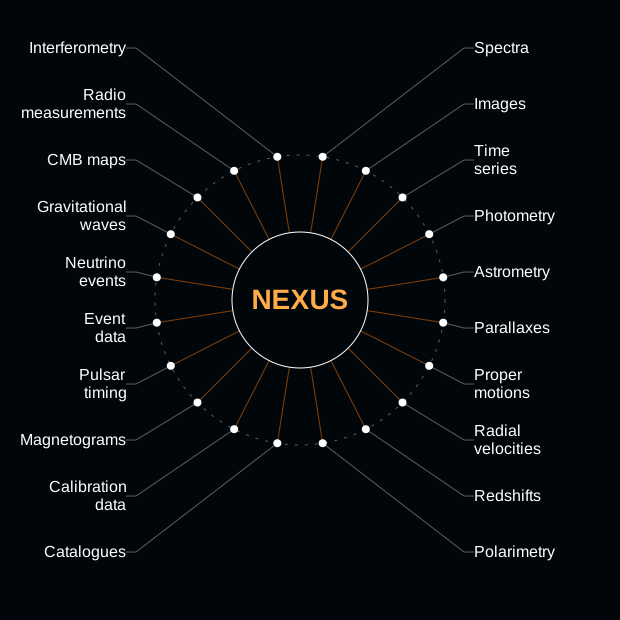
NEXUS is our most ambitious research and development project, currently progressing towards V1 completion: a cross-observatory analytical architecture intended to connect measurements from independent ground-based and space instruments. The goal is to examine the same objects and phenomena from multiple perspectives, compare physical explanations and uncover connections that may remain hidden in isolated analyses.
The long-term aim is to work with every scientifically useful type of data and measurement available from existing telescopes, observatories and their historical archives. Coverage will grow progressively according to data availability, permissions, calibrations and the evaluation of individual integration layers.
From diverse measurements to shared context
Planned inputs include images and maps, spectra and spectral cubes, light curves, pulsar timing, astrometry, redshifts, polarimetry, interferometric measurements, catalogues and individual detection lists. Further directions include cosmological maps, gravitational waves, neutrino events and related experimental products.
Each measurement type requires its own interpretation. NEXUS is intended to align object identification, coordinates, time references, units and uncertainty information while preserving instrument response, calibrations and data provenance. This is essential for meaningful comparisons between observatories.
A cross-evaluation architecture
The proposed architecture connects data ingestion and quality assessment, object and event matching, dynamic-state analysis using GSC-X and comparison of physical-model predictions with observations. Its ambition is unusually broad integration of instruments, data modalities and theories within a reproducible analytical workflow.
Outputs are intended to provide traceable assessments: which measurements support an interpretation, where discrepancies occur, how uncertainties affect the result and what further observation could distinguish competing hypotheses. NEXUS is intended to compare standard models, GDS and other alternatives against the same criteria.
New physics as a testable possibility
NEXUS is intended to identify candidate anomalies, recurring dynamic patterns and discrepancies between models and measurements. These could motivate new hypotheses concerning gravity, stellar and plasma dynamics, compact objects or cosmic evolution.
A candidate new physical phenomenon must withstand alternative explanations, systematic errors and independent data. We therefore plan separate test datasets, checks for instrumental effects and reproducible model comparisons. The objective is to generate and evaluate testable insights rather than automatically treating a discrepancy as a discovery.
Observatory and data-source map
This overview of major public archives and representative instruments provides an initial map for planned NEXUS expansion. It is neither an exhaustive list of all observatories nor a list of working connectors. Availability, terms of use and any proprietary period must be checked for each data release.
| Archive / source | Telescopes, observatories and surveys | Data types |
|---|---|---|
| MAST ↗ | JWST · Hubble · TESS · Kepler/K2 · GALEX · IUE | UV, optical and near-IR images, spectra and time series |
| ESA / ESAC ↗ | Gaia · Euclid · Herschel · Planck · ISO · XMM-Newton · INTEGRAL | Astrometry, catalogues, images, spectra and cosmological measurements |
| NASA HEASARC ↗ | Chandra · XMM-Newton · Fermi · Swift · NICER · NuSTAR | X-ray and gamma-ray data, event lists, spectra and time series |
| NASA / IPAC IRSA ↗ | Spitzer · WISE/NEOWISE · 2MASS · IRAS · AKARI · Planck | Infrared and submillimetre products, maps and catalogues |
| ESO Science Archive ↗ | VLT/VLTI · NTT · ESO 3.6 m · MPG/ESO 2.2 m · VISTA · APEX | Ground-based optical and IR observations, spectroscopy and interferometry |
| ALMA ↗ | Atacama Large Millimeter/submillimeter Array | Millimetre and submillimetre spectra, maps and data cubes |
| NRAO Archive ↗ | VLA · VLBA · GMVA · selected GBT data | Radio interferometry, images and time-domain observations |
| NOIRLab Astro Data Archive ↗ | CTIO · KPNO · Legacy Surveys / DECam | Ground-based survey observations, images and catalogues |
| SDSS ↗ | Sloan Digital Sky Survey | Optical and IR spectra, catalogues and integral-field spectroscopy |
| DESI ↗ | Dark Energy Spectroscopic Instrument | Spectra, redshifts and large-scale-structure catalogues |
| ZTF ↗ | Zwicky Transient Facility | Time-domain variability, images, light curves and catalogues |
| JAXA DARTS ↗ | XRISM · Hitomi · Suzaku · ASCA | X-ray spectroscopy, images and timing data |
| NADC / China-VO ↗ | LAMOST · FAST | Optical spectra and radio observations under individual release policies |
| LAMBDA / CMB ↗ | COBE · WMAP · ACT; Planck via ESA / IRSA | Cosmic microwave background maps, power spectra and derived products |
| SDO / JSOC ↗ | Solar Dynamics Observatory · AIA · HMI | Solar images, magnetograms and velocity maps |
| GWOSC ↗ | LIGO · Virgo · KAGRA · GEO | Public gravitational-wave strain series, event catalogues and metadata |
| IceCube ↗ | IceCube Neutrino Observatory | Public neutrino datasets and supporting products |
| CADC / CFHT ↗ | Canada–France–Hawaii Telescope | Optical images, spectra and calibrations |
| Keck Observatory Archive ↗ | Keck I · Keck II · Keck Interferometer | Optical and IR spectroscopy, images and interferometric data |
| ASTRON / LOFAR ↗ | Low Frequency Array | Low-frequency radio measurements, images and public metadata |
| Pan-STARRS ↗ | Pan-STARRS1 | Optical images and PS1 survey catalogues |
Instrument names identify data sources; they do not imply partnerships or official connections with NEXUS.
Current status as of 26 October 2026 — approximately 75–80% towards NEXUS V1
An internal working estimate dated 26 October 2026 places completion of the NEXUS V1 scientific system at approximately 75–80% (around 78%). This assesses documented capabilities against the target architecture; it is not an automatically measured indicator or confirmation that every function is ready.
The autonomous research engine is the most advanced component. According to the internal development summary, a supervisor already manages experimental cycles without manual instructions for every step. AI Codex contributes to development and the analytical workflow: it reads the research charter and state, selects informative tasks, implements and tests procedures, preserves failures and creates checkpoints. The latest supplied summary references cycle 4674; this is not a live operational indicator.
Autonomy, reproducibility, provenance, failure preservation and experimental discipline are internally estimated at 90–95% for V1. The system distinguishes MEASURED / DERIVED / INFERRED / SIMULATED / UNKNOWN and uses replay, hashing, null tests and control scenarios. GDS and GSC-X remain frameworks under test whose hypotheses may also be rejected.
Connecting analysers, evidence admission and preparation for cross-observatory fusion are estimated at 65–75%. A catalogue time overlap alone is not treated as evidence of simultaneous physical measurements, and unfinished outputs are not presented as results.
Integration is the largest remaining task. The Global Observation Census is intended to identify measurements, instruments, bands, ObsIDs, times, calibrations and uncertainties. The Universal Acquisition Layer should then find → acquire → verify provenance → interpret the product → assign an adapter → analyse. This area is internally estimated at 50–70%, depending on the observatory; general interpretation of arbitrary files is not complete.
The Scientific Adjudicator is estimated at 30–40%. It is intended to consolidate evidence into traceable conclusions: SUPPORTED BY CURRENT EVIDENCE, CONTRADICTED WITHIN TESTED DOMAIN or INSUFFICIENT DATA. These are target decision categories, not findings about a specific theory announced here.
The unified natural-language and graphical product layer is estimated at approximately 30%. The V1 completion objective is reliable execution of a scientific mission from an ordinary user question without manually directing each step.
What has already been evaluated in practice
NEXUS development is not based solely on a simulated architecture. Some analytical layers have also been evaluated using real astronomical data and archives. Work to date includes processing JWST/MIRI and JWST/NIRSpec products, spectral and instrumental checks, relative astrometry and motion measurements, time-domain analysis of TESS data, and work with catalogue and timing information from multiple X-ray observatories.
Validation includes null tests, checks for instrumental artifacts, reproducible replay runs, hashing of results, and separation of directly measured quantities from derived, simulated or currently unknown parts of the evidence.
Within NEXUS, GSC-X is used only where its nonlinear analysis has a physical or statistical justification, and it is compared with conventional methods. Likewise, GDS enters the system as a testable physical framework rather than a predetermined explanation. A test can therefore support a hypothesis, leave it unresolved or reject it within the tested domain.
What NEXUS cannot yet do
NEXUS is not yet a universal analyser of arbitrary scientific files without prior verification of their meaning. A new instrument or data-product type may still require development and validation of an adapter, as well as checks of units, coordinate and time systems, calibrations, instrument response and uncertainty structure.
Fully autonomous acquisition and physical integration of all relevant data from every observatory are also not complete. Some areas are already well developed, while others — including full radio interferometry, gravitational waves, neutrinos, polarimetry and other specialised modalities — remain part of the integration layer being progressively built.
We therefore describe the current state of NEXUS as V1 development rather than a completed universal scientific product.
What a completed NEXUS V1 will mean
A completed NEXUS V1 is intended to accept a clearly defined physical question or research object in ordinary language and autonomously construct a scientific mission.
The system should identify relevant objects and their identifiers, locate available observations, select suitable observatories and instruments, acquire and verify data, assign appropriate analytical procedures, align temporal and spatial context, assess uncertainties and systematic errors, and compare competing physical hypotheses.
The output should be more than a numerical result: an auditable scientific conclusion containing both supporting and opposing evidence, analysis limitations, the degree of independence between measurements, and a proposed further observation that could distinguish competing hypotheses.
QUESTION → OBSERVATIONS → ACQUISITION → ANALYSIS → FUSION → FALSIFICATION → ADJUDICATION → REPORT